
Selecting the Right Solar Panel System Size
When designing your solar panel installation, it is important to select the right solar panel system size. The size of the system that you require will depend on your energy needs and the available space for the panels.
Determining your electricity usage
We will require your annual electricity usage to determine the correct system size for your home. The easiest way to find out how much electricity your home uses annually is to look at your last electricity bill where the amount of electricity your home uses will be in kWh. If this figure is not on your electricity bill, it is best to call your electricity provider to ask for your home’s yearly consumption. To put this figure in perspective the average UK home’s annual electricity usage is 2900kWh.
Determining how many solar panels can fit on your roof
When we are designing your solar panel system, we will look at your roof using remote satellite imagery. This allows our designers to measure the height and width of the available roof space and identify any obstacles on your roof such as roof windows, vents or chimneys. For solar panels situated near the edge of the roof, a small margin must be left to allow for wind uplift. This is where excessive wind can be directed under the solar panels causing a lifting effect that can cause more strain and forces going through the brackets, bolts and roof rafters. This margin is subtracted from the available roof area and then a simple calculation is done taking into consideration the solar panel dimensions and a standard 20mm gap between joining solar panels to allow for the clamps that hold the solar panels to the rails. From this calculation, you will have the amount of solar panels that will fit in the available roof area.
How much power will you get from the array?
The first figure you will need to calculate is the maximum power that the array could output. This is done by multiplying the chosen solar panel output by the number of panels in the designed array.
For example, an array with ten 430W panels would be 10 x 430=4300W or 4.3kWp
This value is the maximum that this solar panel array could generate if all the other conditions are perfect. No solar panel array is perfect, to calculate the actual performance of the solar panel array when installed on your property there are rating factors that must be multiplied to the maximum array size to take into account the location in the country your home is, the angle of the array and any shade that might cover the solar panels.
Solar Radiation or kk Factor
The first rating factor is called the solar radiation factor (kk value) which is essentially the amount of sun that your roof receives. This value is a combination of your home’s location, the direction the panels are facing and their angle.
Each region in the country has a designated number.
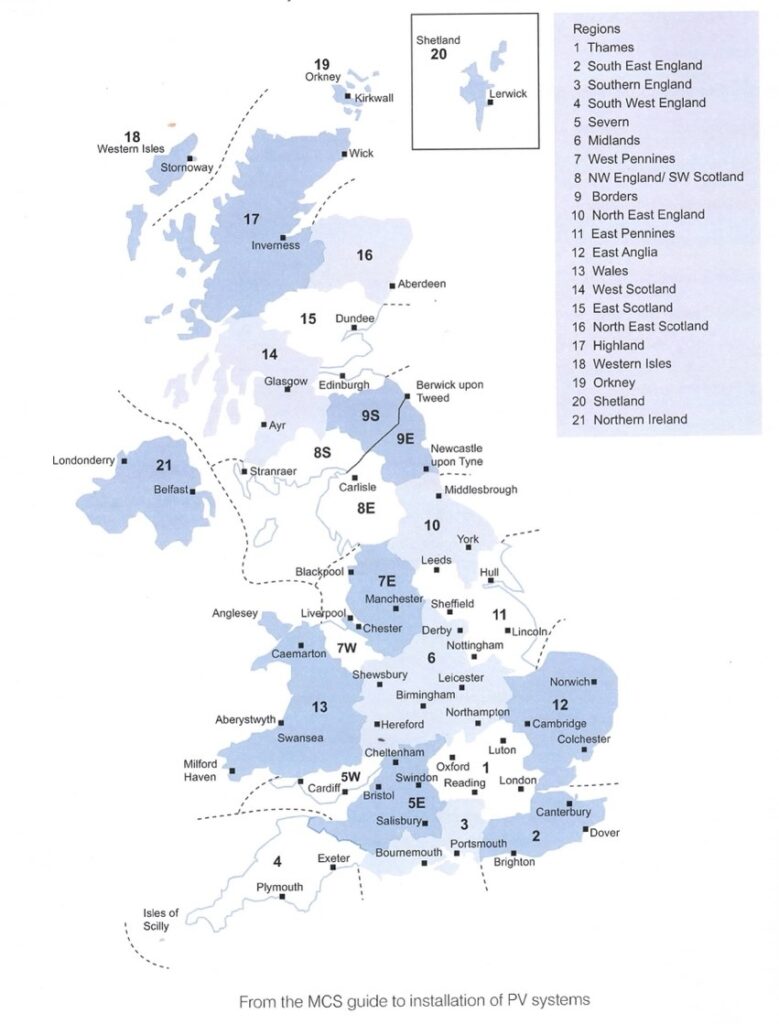
When we have the number for your homes post code area we refer to the kk value chart. The chart looks like this.
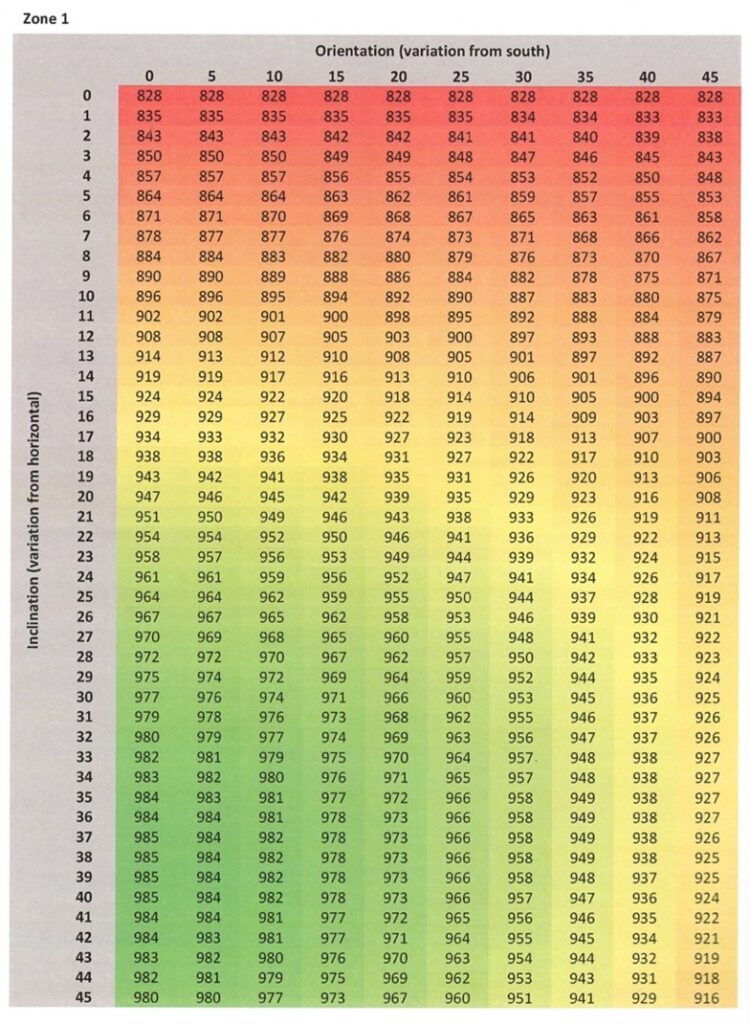
One side of the chart represents the direction that the solar array is facing in degrees from south and the other side of the chart represents the angle of the solar panels in degrees. When cross-referencing both values you will get a three-figure number which is the kk value for your solar array.
Shade Factors
The next step is to calculate your shading factors. This is a number from 0 to 1 with 0 being full shade over every panel and 1 being no shade is ever on the panels. In most cases, we can assess from our remote images and consult with the client to assess the level of shade that will affect the roof.
Calculating the Estimated Annual Output
The final step is to take all the rating factors for the solar array and multiply them to the array size. The formula looks like this
Estimated Annual Output (kWh/yr) = Array Size (kWp) x Solar Radiation factor (kk) x Shade Factor (SF)
Example
Array size 4.3kWp x Solar Radiation 980 x Shade Factor 1= 4214kWh Estimated Annual Output
In the above example, the estimated annual output for this solar array is 4214kWh. This is the estimated amount of electricity that the solar panel array will generate for its location and size in a year.
How much of the estimated annual output will you use in the property?
To calculate how much of the free electricity that you generate will be consumed in the property another factor to consider is how often you are home throughout the day. This is relevant because the solar array will be generating power during daylight hours. To assess the impact of this, there are three categories which are home all day, in half the day and out all day. Depending on which one applies to your situation we will then multiply another correction factor to your estimated annual usage to calculate how much of the electricity generated by the solar panels will be consumed In your home. If you don’t have a battery to store the extra power it will be exported to the grid and you will be paid for that electricity exported. MCS estimates that only about 30% of all the electricity generated by a typical solar panel installation without a battery would be consumed in the home. If you have a battery then the extra electricity that would have been exported to the grid can now be stored to be used when the sun is not shining. MCS estimates that around 80% of the electricity generated by a typical solar installation with a battery would be consumed in the home.
How to size your battery?
When deciding on which battery size will suit your home it is important to remember that all home’s individual energy needs are different. As a rule of thumb, the battery size should be around double the array capacity. This is so that the solar panel array will generate enough power to charge the batteries capacity throughout the day. So for a 5kW solar panel array, it would be advisable to have a battery capacity of around 10kWh. If you have a battery that is too small, then the extra power generated by the solar panel array will fully charge the battery quite fast and then any extra electricity generated that day will be exported to the grid. If the battery is too big the solar panel array will not have the capacity to charge the battery fully throughout the day which will mean that the extra capacity is unused. That is why it is important to select an appropriate battery size for the solar array.
Conclusion
When designing a solar panel installation many factors must be considered. This can be a bit overwhelming for most people but at least you now have more of an understanding about the process and how the correct size of the installation is determined to best suit the requirements of your home. When My Green Electricity complete a solar assessment on your property and then advise you on the most suitable system and size we will highlight all the figures such as the estimated annual generation, how much of the electricity generated by the solar will be used inside of your home, the savings on your electricity bills and if you choose a battery then we will show you how much of the battery you will use.
If you would like to receive a free solar report for your home from My Green Electricity call 03330911700 or email info@mygreenelectricity.co.uk