
If you’ve looked at your energy bills recently, you don’t need a data analyst to tell you that the cost of keeping the lights on has drastically changed over the last decade. While most homeowners know that electricity has become more expensive, few realise just how the financial dynamics of generating your own power have shifted.
At My Green Electricity, we are founded on transparency and helping UK households gain true energy independence. To give you the clearest picture possible of the modern energy landscape, we analysed historical data tracking average UK grid electricity prices against the average cost of installing a standard 4kW domestic solar panel system.
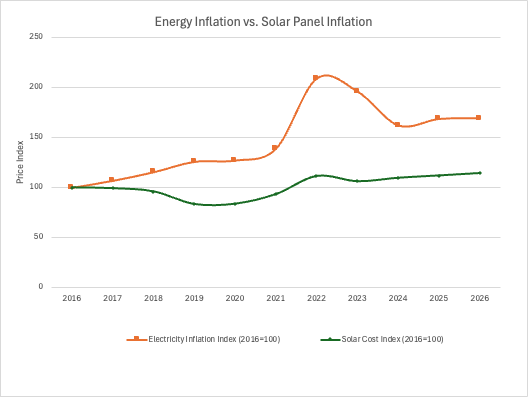
The results reveal a stark reality: while the cost of installing solar has experienced mild, supply-driven fluctuations, grid electricity inflation has completely transformed the return on investment (ROI) for homeowners. Generating your own green energy isn’t just an environmental choice anymore—it can help protect you and your family from energy inflation.
The Numbers: Energy Trends at a Glance (2016–2026)
To understand where we are going, we have to look at where we started. The table below outlines the average cost of domestic electricity (pence per kWh) alongside the average turnkey installation cost for a standard 3-bedroom home’s 4kW solar array, tracked alongside their respective inflation indexes since 2016.
| Year | Avg. Electricity Price (p/kWh)* | Avg. Annual Household Energy Cost (£) | Electricity Inflation Index (2016=100) | Avg. 4 kW Solar System Cost (£) | Solar Cost Index (2016=100) |
| 2016 | 15.4p | £1,118 | 100 | £6,568 | 100 |
| 2017 | 16.5p | £1,152 | 107.1 | £6,516 | 99.2 |
| 2018 | 17.8p | £1,215 | 115.6 | £6,304 | 96 |
| 2019 | 19.4p | £1,239 | 126 | £5,476 | 83.4 |
| 2020 | 19.6p | £1,098 | 127.3 | £5,500 | 83.7 |
| 2021 | 21.4p | £1,212 | 139 | £6,128 | 93.3 |
| 2022 | 32.2p | £2,230 | 209.1 | £7,316 | 111.4 |
| 2023 | 30.2p | £2,242 | 196.1 | £6,968 | 106.1 |
| 2024 | 25.0p | £1,775 | 162.3 | £7,200 | 109.6 |
| 2025 | 26.0p | £1,715 | 168.8 | £7,350 | 111.9 |
| 2026 | 26.1p | £1,754 | 169.5 | £7,505 | 114.3 |
Over the last 10 years, the average UK household’s energy cost has increased by 69.5%, whilst solar panel installation has increased by just 14.3%
*Grid Electricity Prices (Historical & Current Metrics): Compiled utilising data from the Office for National Statistics (ONS) Consumer Price Indices and Ofgem (Office of Gas and Electricity Markets) Fuel Price Cap Historical Datasets (2016–2026).
Deconstructing the Grid: Why Did Electricity Prices Skyrocket?
Looking at the data, grid electricity prices have experienced an overall net inflation of 69.5%. At the peak of the global energy crisis in 2022, prices more than doubled compared to our 2016 baseline, soaring to over 32p per kWh. Why did this happen?
- The Wholesale Gas Trap: Historically, the UK has relied heavily on natural gas to generate a substantial portion of its grid electricity. When geopolitical conflicts and supply chain constraints squeezed European gas markets, the wholesale cost of electricity spiked exponentially. Because of the UK’s marginal pricing system, the most expensive power source (gas) dictates the final price of electricity across the board.
- Rising Network and Standing Charges: Even as wholesale energy markets eased slightly after the crisis, consumers noticed another hit: standing charges. The fixed cost of maintaining the physical grid infrastructure, managing supplier failures, and investing in upgrades has risen steadily, locking high minimum costs into every monthly bill regardless of how much energy a household saves.
The Truth About Solar Costs: Why Have Prices Shifted?
A common misconception is that technology always gets cheaper over time. While solar panel manufacturing expanded globally, lowering hardware costs dramatically until 2019 (when a 4kW system hit a record low average of £5,476), the post-pandemic landscape introduced new variables:
- The Post-Crisis Demand Surge: When grid prices surged in 2022, consumer demand for solar installation in the UK reached unprecedented levels. This placed massive pressure on localized supply chains and, crucially, available labor.
- Scaffolding and Localised Labour Inflation: Installing solar requires certified, highly technical skillsets (MCS and NAPIT accreditations) and safe physical access. Over the last few years, the UK construction and engineering sectors have faced steep inflation in labour rates, transport, insurance, and scaffolding costs. This is why a turnkey installation rests higher today (around £7,505) than it did during its 2019 baseline.
The Financial Reality: The Payback Gap Has Widened
Here is the most important takeaway for a homeowner: Even though solar panels cost roughly 14% more to install today than they did in 2016, grid electricity is nearly 70% more expensive.
The true financial value of solar isn’t determined by the upfront cost alone; it’s determined by the difference between the cost of self-generation and the cost of buying from the grid. Because grid electricity remains stubbornly high, every single kilowatt-hour your roof generates saves you significantly more money today than it would have a decade ago.
When you factor in the ability to sell your excess power back to the grid via modern export tariffs, the investment case changes entirely. Payback periods that used to stretch well past 10 to 12 years have shortened down to 6 to 9 years for optimized systems. After that period, your system continues to provide free, clean electricity for the remainder of its 25+ year lifespan.
Actionable Advice for UK Consumers
If you are looking to insulate your household budget from future grid volatility, here is our expert guidance on how to navigate the current market:
1. Pair Solar with Battery Storage
Solar panels generate power during the day, but peak household usage happens in the morning and evening. Without a battery, your excess daytime energy gets pushed back into the grid. By adding a home battery storage system, you can hoard your free daytime generation and power your home through the night. Furthermore, a battery allows you to participate in “smart tariffs,” charging your battery from the grid during ultra-cheap overnight hours if needed.
2. Make the most the 0% VAT Incentive (Before March 2027)
To encourage clean energy adoption, the UK government introduced a 0% VAT relief scheme on energy-saving materials. This applies to solar panels and—critically—home battery installations (even if retrofitted later). This saving can slice thousands of pounds off a standard installation quote, but the relief is legally structured to run until March 31, 2027. Waiting too long could mean automatically adding up to 20% back onto the cost of your project.
3. Shop Around for Premium Smart Export Guarantees (SEG)
You don’t have to accept a baseline 4p or 5p per kWh export rate from your standard energy provider. Dynamic, tech-forward suppliers now offer premium export rates (some ranging from 15p up to nearly 30p per kWh during peak hours for homes with integrated battery setups). Choosing the right export tariff can shave years off your system’s payback timeline.
4. Prioritise Regional, Accredited Installers
With the post-pandemic boom came a influx of national sales brokers charging inflated margins. For total peace of mind, always choose an installer that holds direct MCS (Microgeneration Certification Scheme), NAPIT, and RECC certifications. Working with a dedicated local provider ensures you avoid high-pressure sales tactics, receive a bespoke design suited strictly to your roof’s orientation, and enjoy long-term, accessible workmanship warranties.
5. Focus on a well-designed, well-placed solar system
Getting the most out of your solar panels is about more than simply installing them and hoping for the best. A well-designed system will take into account direction, shading, battery storage, panel cleanliness, system sizing and how you use electricity at home. A good, well-planned system can maximise your return on investment.
Final Thoughts
Cheap, predictable grid energy is difficult to come by. While we may see minor seasonal dips in the Ofgem price cap, the baseline cost of buying electricity from centralised power plants remains permanently elevated.
By taking control of your own roof space, you aren’t just reducing your carbon footprint—you are buying your electricity in advance at a fixed, predictable rate.
If you are based across Yorkshire—whether in Wakefield, Leeds, York, Sheffield, Harrogate, or Huddersfield—at My Green Electricity we’re here to help you design and fit a solar system that works for your home.